Bitcoin Holds Above $78K as Ethereum Outperforms Amid Cooling DeFi Activity
TokenPost.ai
Cryptocurrency prices pushed higher early Monday, with Bitcoin (BTC) holding above $78,000 and Ethereum (ETH) outperforming most large-cap tokens—signals of improving risk appetite even as activity in DeFi and stablecoins cooled.
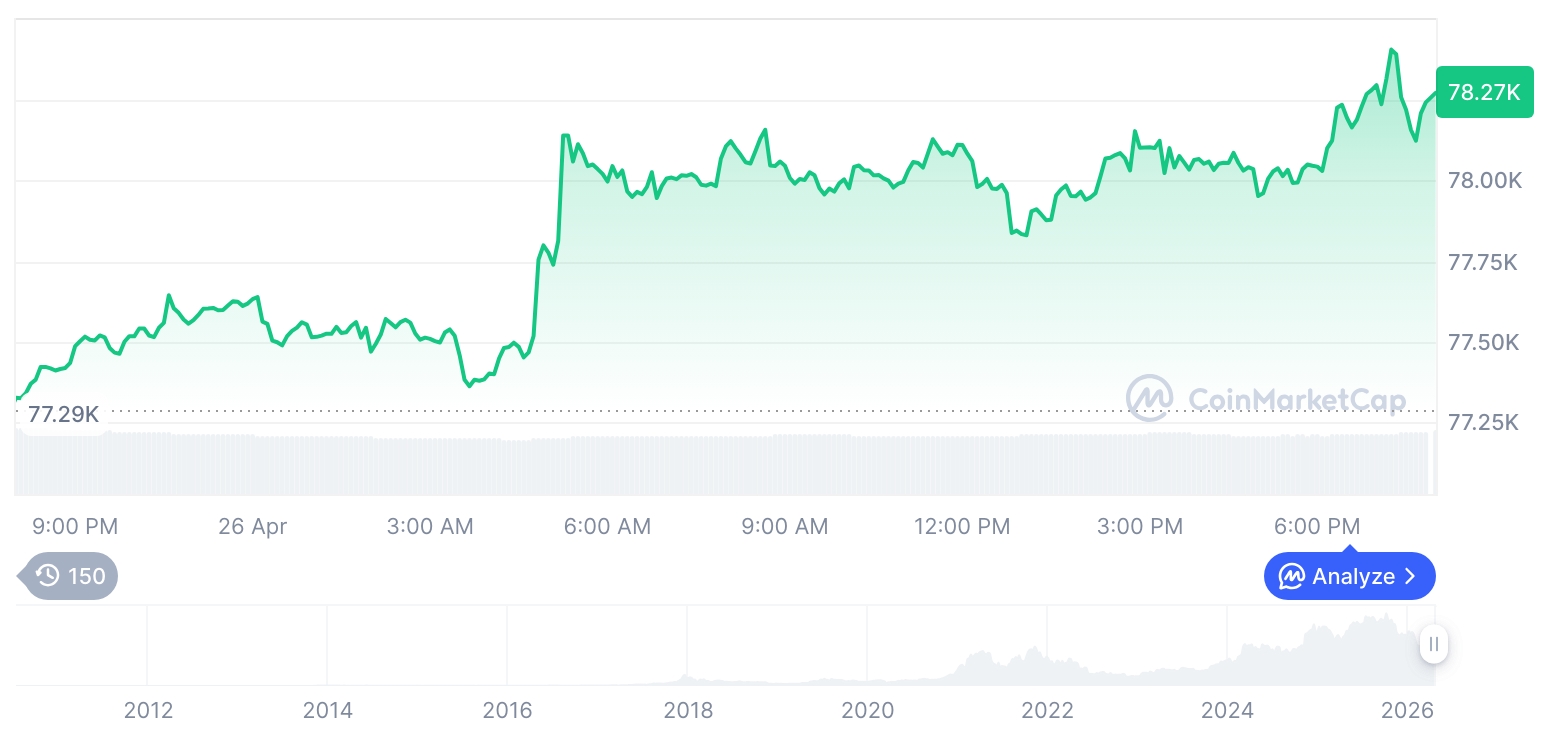
As of 4:04 p.m. Sunday ET, Bitcoin traded at $78,263, up 1.21% over the prior day, according to TokenPostMarket data. Ethereum rose 2.56% to $2,369, extending a relative-strength streak that has helped broaden sentiment beyond BTC-led rallies.
Major altcoins were mostly in the green. XRP (XRP) added 0.77%, BNB (BNB) gained 1.14%, Solana (SOL) climbed 1.44%, and Dogecoin (DOGE) rose 1.66%. Hyperliquid (HYPE) advanced 2.02%, while Tron (TRX) was the lone notable decliner among the group, slipping 0.05%.
Market-wide capitalization stood at $2.615 trillion, with total 24-hour spot volume reported at $96.5 billion. Altcoins accounted for $1.048 trillion of total market value and posted $78.7 billion in 24-hour volume, underscoring continued participation outside Bitcoin despite the market’s still BTC-heavy structure.
Bitcoin’s 'dominance'—its share of the total crypto market cap—edged down to 59.92%, a marginal 0.01 percentage-point decrease on the day. Ethereum’s dominance increased to 10.94%, up 0.14 percentage points. The combination of a slight dip in BTC dominance and a firmer ETH share is often interpreted as a tentative rotation toward altcoins, particularly when paired with broad-based gains among large-cap tokens.
Under the surface, however, parts of the on-chain economy showed softer activity. The DeFi sector’s market cap was reported at $62.9 billion, with 24-hour volume of $8.6 billion—down 3.81%—suggesting that the price bounce has not yet translated into uniformly stronger decentralized trading and lending flows.
Stablecoins also saw a contraction in turnover. Total stablecoin market cap was $292.7 billion, while 24-hour trading volume fell 8.62% to $139.0 billion. Lower stablecoin volume can indicate reduced near-term deployment of sidelined capital, even during upward price moves, and may point to a more cautious pace of spot buying.
Derivatives activity remained the standout. Crypto futures and options recorded $473.1 billion in 24-hour trading volume, up 4.46% from the previous day—far exceeding spot turnover. Rising derivatives volume alongside a market rebound can reflect 'leveraged positioning' and heightened sensitivity to short-term volatility, as traders use perps and options to express directional views or hedge exposure.
Overall, the session reflected a constructive tone: BTC and ETH advanced in tandem and most major altcoins followed. Still, declining DeFi and stablecoin volumes suggest some investors are waiting for clearer confirmation, while elevated derivatives trading indicates markets may remain prone to sharper swings as leverage builds.
Article Summary by TokenPost.ai
🔎 Market Interpretation
- Broad risk-on impulse: Crypto prices rose with BTC holding above $78K and ETH leading, indicating improving risk appetite across large caps.
- Early signs of rotation: BTC dominance dipped to 59.92% while ETH dominance rose to 10.94%, a combination often read as tentative capital shifting toward altcoins.
- Participation beyond Bitcoin: Altcoins represent $1.048T of market cap and $78.7B in 24h volume, supporting the idea that the move is not solely BTC-driven.
- Spot vs. on-chain divergence: Despite higher prices, DeFi volume fell 3.81% and stablecoin volume fell 8.62%, suggesting the rally isn’t yet matched by stronger on-chain transaction activity or fresh spot deployment.
- Leverage leads the tape: Derivatives volume surged to $473.1B (+4.46%), far above spot, implying the upswing may be amplified by leveraged positioning and could stay sensitive to volatility.
💡 Strategic Points
- Confirm the rotation before chasing: A small BTC-dominance decline can be noise. Watch for continued ETH outperformance and repeated breadth in majors (SOL/BNB/XRP/DOGE) to validate an alt-friendly regime.
- Use on-chain activity as a “strength filter”: If DeFi and stablecoin volumes keep lagging, price gains may be more positioning-driven than demand-driven—potentially less durable.
- Monitor stablecoin turnover for dry powder signals: Falling stablecoin trading volume can indicate slower capital deployment. A rebound in stablecoin flows often precedes stronger spot continuation.
- Respect leverage risk: With derivatives overwhelmingly dominating volume, the market may be prone to liquidation cascades and sudden reversals. Consider tighter risk controls (position sizing, stops, hedges) during leverage-heavy rebounds.
- Key levels and drift risk: BTC holding ~$78K supports sentiment, but if spot volume doesn’t expand while derivatives rise, upside can become fragile and news-sensitive.
- Relative-strength cue: ETH’s continued outperformance can be used as a sentiment gauge—ETH leading often coincides with broader risk-taking versus BTC-only rallies.
📘 Glossary
- Dominance: The percentage of total crypto market capitalization attributed to a specific asset (e.g., BTC dominance).
- Large-cap tokens: Cryptocurrencies with high market capitalization and typically deeper liquidity (e.g., BTC, ETH, BNB, SOL).
- DeFi (Decentralized Finance): On-chain financial applications such as lending, swaps, and derivatives that operate via smart contracts.
- Stablecoins: Tokens designed to track a stable reference price (commonly USD) and often used as trading collateral and “cash” in crypto markets.
- Spot volume: Trading volume for immediate settlement (buying/selling the underlying asset directly).
- Derivatives: Instruments like futures/perpetual swaps and options whose value derives from an underlying asset’s price.
- Leveraged positioning: Using borrowed funds or margin to increase exposure, which can magnify gains and losses and raise liquidation risk.
- Rotation: A shift of capital from one segment to another (e.g., from BTC into ETH/altcoins) based on risk appetite and relative performance.